
AI Hype and AI Warnings Rest on the Same Belief
Record AI investment and loud warnings about AI can come from the same company in the same week. Both rest on the belief that AI will become very capable.
Anthropic raised $81.3 billion on November 19, reported as the largest IPO on record. Its own leaders warn publicly about the harm powerful AI could cause. Over the same weeks the press carried stories on AI harm, protests against new data centers and warnings of an AI bubble. Investors paid for what that capability could earn, and the safety warnings are about the damage it could do. The two sides disagree about the outcome and agree on the premise.
The bubble warnings are a different kind of pessimism. They ask whether the money spent on AI will pay back, and the answer depends on what happens inside the organizations trying to use it.
Mood follows information
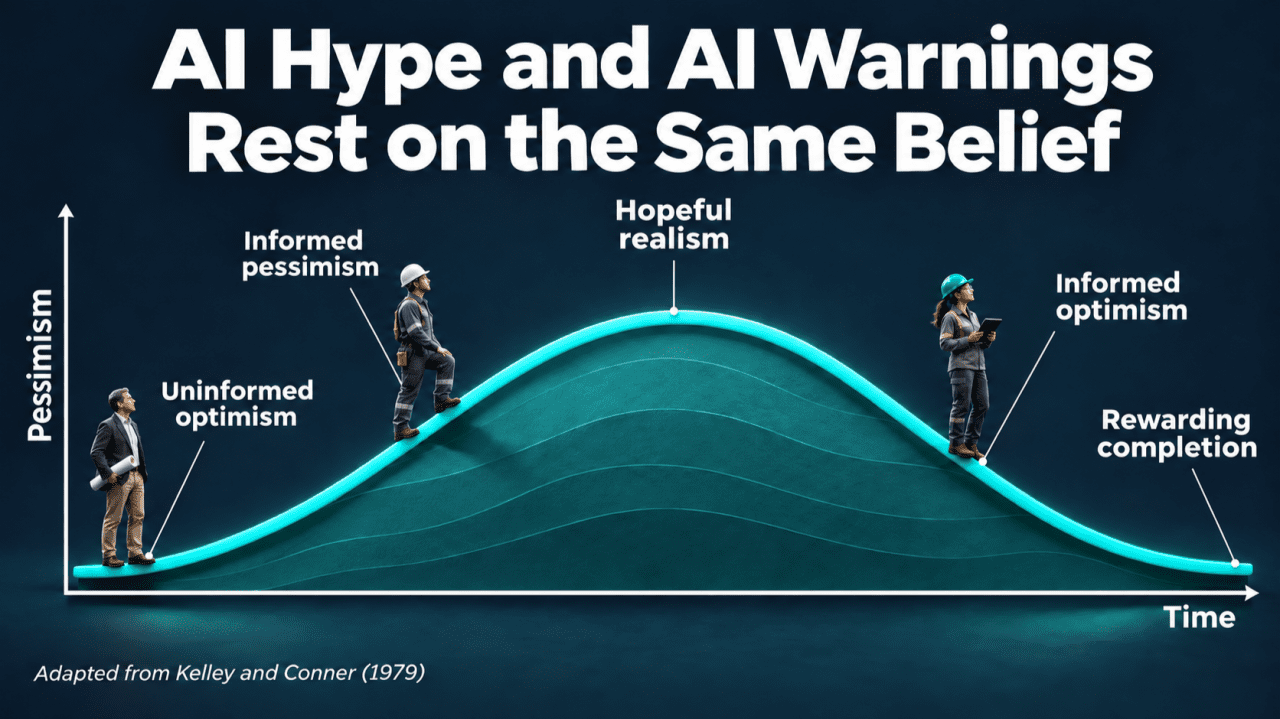
In 1979 Don Kelley and Daryl Conner published “The Emotional Cycle of Change” for people who help organizations through planned change. Earlier models, such as Kübler-Ross’s stages of grief, described how people react to change forced on them. Kelley and Conner looked at change people choose, and argued that it meets resistance too. Their examples were management programs of the time, such as setting objectives with each employee and team building, and they put the lesson in one line: “change is always tougher than it looks.”
Their model has five stages, each with a feeling attached:
Uninformed optimism (certainty). The project looks great on paper, and morale is at its peak. Informed pessimism (doubt). Problems surface, few solutions are available, and people ask why they ever got involved. Hopeful realism (hope). The problems are still there, but success moves from possible to probable. Informed optimism (confidence). Confidence grows from having solved real problems. Rewarding completion (satisfaction). The change is done, and it usually looks different from what people expected at the start.
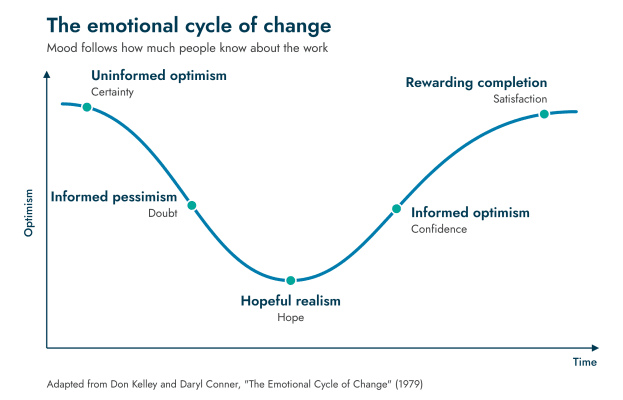
Kelley and Conner tie the mood to information. Optimism and pessimism depend on how much people know about what the work requires, and early optimism is, in their words, “low-data.” Pessimism rises because people learn what the change takes, so the mood tells you how much people know about the work. It is a poor guide to whether the change is worth making, which is the question investors, boards and plant managers need answered.
Many curves at once
The AI market is thousands of these curves running at the same time. Someone who just watched a new model do something impressive is at uninformed optimism. A team trying to get an agent to work reliably in production is often at informed pessimism. A team with a narrow use that pays for itself has reached informed optimism. Cameron Herold, in a 2008 version of the model, added that the cycle repeats, so each new capability starts another round and one company can sit at different stages for different uses of AI.
McKinsey’s 2026 survey shows the overlap in aggregate. The share of respondents saying AI is scaling across their organization rose from 38 to 44 percent in a year, while the share reporting any contribution to operating profit stayed at about 37 percent. More deployment with flat returns is what you would expect when many organizations are sitting at informed pessimism, and it gives both the enthusiasts and the skeptics a number to quote.
Quiet withdrawal from AI projects
Kelley and Conner describe informed pessimism as “a dangerous one” for change projects. This is where people leave, which they call “checking out,” and they describe two ways of doing it. Public withdrawal is visible: people refuse to take part, or the organization cancels the project. Private withdrawal is not. People go through the motions, or the project stays officially alive while everyone knows management no longer cares about it. The authors call private withdrawal the more dangerous of the two, because nobody acknowledges it, so nobody can respond to it.
Public withdrawal from AI is easy to count. A SnapLogic survey of 1,000 IT decision-makers, released on November 17, found that 54 percent of their organizations had abandoned agentic AI projects because of unclear business value. Quiet withdrawal does not show up in a survey like that.
In a plant, quiet withdrawal looks like an AI pilot that is still running and on the project report. The agent produces recommendations. The operators have stopped reading them, or override them without recording why, and the reliability engineer no longer checks the alerts. Nobody cancels anything.
The paper lists the private thoughts behind this kind of withdrawal, including these two: “I really want this change to work, but I can’t seem to find the time to come to the meetings and get involved,” and “The change can’t possibly work and our manager knows it, but she’s afraid if she says anything, she won’t get her promotion.”
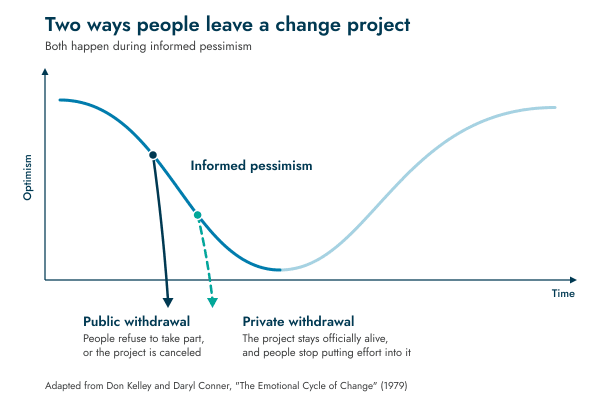
To find quiet withdrawal, look at usage: how often people open the agent’s recommendations, how often they act on them, how often they override them, and whether each override carries a reason. A pilot with a healthy status and falling usage has already been abandoned by the people it was built for. That is informed pessimism nobody has said out loud, and a team can only work through it once someone does.
The stages in industrial operations
Uninformed optimism: “An agent can diagnose the problem and take action.” Informed pessimism: “What information does it need? What is it allowed to change? How do we catch a wrong recommendation? Who is accountable?” Hopeful realism: “It works on one production unit, and we know where it fails.” Informed optimism: “Within these operating limits, with these permissions, these checks on its evidence and these points where it hands over to a person, it delivers a benefit we can measure.”
The questions at the second stage are the engineering work the demo left out. Answering them is how a team moves on. Most of the work in industrial AI is getting from the second line to the last one.
Kelley and Conner also note that the finished change rarely matches the first plan, because the goals and the methods shift along the way. For industrial AI, that can mean the agent in daily use does less than the demo promised, inside tighter limits and with more points where it hands over to a person, and still pays for itself.
What if only the mood changes …
Kelley and Conner describe a predictable sequence, but their paper offers no data to show that every person or organization follows it. A drop in mood does not mean recovery comes next; that depends on the technology and its economics. The cycle also says nothing about the safety argument, which concerns AI becoming too capable, a separate question from whether it is hard to deploy.
When confidence in AI rises or falls, **check what changed: the capability, the cost to deploy it, the value it has shown, or the risk.**Kelley and Conner built their model on the idea that mood follows information. If none of those four moved, only the mood did.
Sources
Don Kelley and Daryl R. Conner, “The Emotional Cycle of Change,” The 1979 Annual Handbook for Group Facilitators (J. E. Jones and J. W. Pfeiffer, eds.), reprinted in The Pfeiffer Library, Volume 3, 2nd edition (1998), pp. 384-389: https://snuhome.org/~jsmith/library/body/v03.pdf#page=384 Cameron Herold, guest post on Tim Ferriss’s blog (2008): https://tim.blog/2008/10/03/harnessing-entrepreneurial-manic-depression-making-the-rollercoaster-work-for-you/ McKinsey, “The state of AI in 2026: On the road to ROI” (August 2026): https://www.mckinsey.com/capabilities/quantumblack/our-insights/the-state-of-ai SnapLogic, 2026 Agentic Enterprise Readiness Index (November 17, 2026), as reported by CDO Magazine: https://www.cdomagazine.tech/aiml/snaplogic-survey-finds-enterprises-abandon-agentic-ai-projects-over-unclear-business-value Anthropic IPO: https://www.cnbc.com/2026/11/20/anthropic-defies-odds-holding-ipo-despite-massively-disruptive-market.html
Pieter van Schalkwyk is the CEO of XMPro, specializing in industrial AI agent orchestration and governance. Drawing on 30+ years of experience in industrial automation, he helps organizations implement practical AI solutions that deliver measurable business outcomes while ensuring responsible AI deployment at scale.
He is the lead author of the Industrial AI Agent Manifesto, published by the Digital Twin Consortium in February 2026, a governance framework for trustworthy autonomous operations.
Our GitHub Repo has more technical information. You can also contact myself or Gavin Green for more information.
Read more on MAGS at The Digital Engineer
How this was made: I worked with Claude to check sources, draft from my direction and edit, and with Codex to review the argument and evidence. I do not publish anything I have not rewritten myself.
This article originally appeared on XMPro CEO’s LinkedIn blog, The Digital Engineer, on 24 November 2026.