
From Harness to Graph: What the Next Wave of AI Engineering Means for Industrial Operations
Three months ago, I wrote about why your AI agent needs a harness — the runtime infrastructure that governs what an agent sees, what it can do, and what happens to what it produces. The argument was simple: the model isn’t the hard part. The environment around it is.
But the AI engineering conversation has already moved again. In July 2026, a term emerged that sharpened the harness concept into something more specific: graph engineering — the discipline of designing the topology of an AI system as an explicit, inspectable graph of agents, tools, deterministic logic, and governance gates. The claim is that the graph itself — who connects to what, where reasoning happens, where rules hold the line — is the primary engineering artifact. Not the model. Not even the harness in the abstract. The structure.
From prompts to graphs
The AI engineering community has been climbing a progression for two years, each step widening the frame. Prompt engineering controls what you ask the model. Context engineering controls what the model sees. Harness engineering controls what the model can do. Loop engineering controls how the work continues without you. Graph engineering is the next layer — it controls how multiple components coordinate as a system: which nodes exist, what each is responsible for, which transitions are permitted, and how state flows between them. Where a loop governs one agent’s cycle, a graph governs the topology across agents, deterministic functions, retrievers, validators, routers, and human checkpoints.
These layers compose. They don’t replace each other.
A graph whose nodes have poorly engineered loops is an org chart of unreliable employees. A graph with excellent loops but accidental topology is coordination failure at scale.
The term itself is weeks old — Peter Steinberger sparked it with a one-line post in mid-July 2026. But the practice is much older. It’s been inside state machines, directed acyclic graph (DAG) orchestrators, and workflow engines for decades. Graph engineering is a naming event for something that already existed. And it turns out, one of the places it has existed longest is industrial operations.
What graph engineering looks like in practice
Take an alarm triage workflow at an industrial facility.
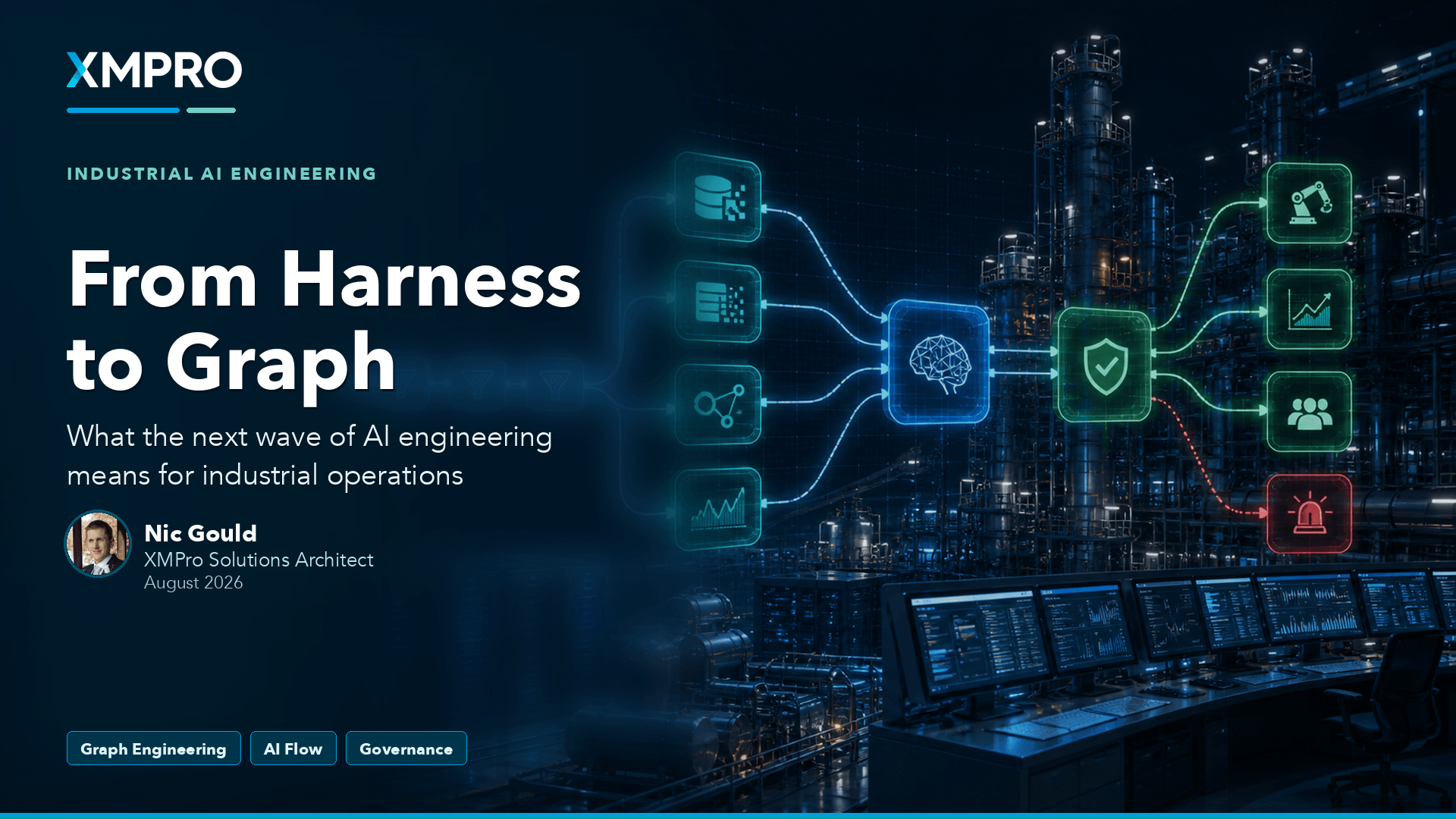
An equipment alarm enters from the left. A deterministic filter screens out noise — no model involved, just rules. The pipeline fans out into three parallel branches, each retrieving context from a different system: maintenance history from the enterprise resource planning (ERP) system, recent sensor trends from the process historian (the time-series database that records operational sensor data), and semantically similar past alarms from a knowledge base. The results converge at a join, are ranked by relevance, and flow into the single AI-powered node in the pipeline — the large language model (LLM) reasoning step, visually distinct because it’s the only node that isn’t deterministic. A governance gate checks the output: confidence scoring, schema conformance (does the output match the expected structure?), and faithfulness (is the response grounded in the context it was given?). Conditional routing sends the result down different paths based on what it contains.
Count the nodes. Most of them have nothing to do with language models. The AI is one step in a pipeline that is otherwise entirely deterministic — filters, retrievers, joins, validators, routers. The graph is governing the agent, not the other way around.
Every principle the graph engineering community has identified — explicit topology, heterogeneous node types, governance at the graph level, observable state flow, fan-out and join, conditional routing — is present in this pipeline. And it runs on a visual canvas where the entire topology is the designed, versioned, inspectable artifact.
The industrial graph engineering surface
That pipeline is an XMPro DataStream, built on the AI Flow harness layer.
The topology isn’t defined in code. It’s composed visually on a canvas by process engineers and reliability specialists — people who understand the operational domain, not software developers. Every node is independently observable in real time: you can inspect what data arrived, what transformation occurred, what the model received, what it produced, and what happened downstream. Every edge is explicit. The graph is the thing you design, maintain, and hand to the next engineer.
The principles now being articulated in the graph engineering discourse describe exactly this: the topology should be an explicit, inspectable artifact. Nodes should be heterogeneous — agents, tools, deterministic logic, governance gates — not agent-only. State should flow visibly through defined edges. Governance belongs at the graph level, not hidden inside individual nodes.
XMPro DataStreams have worked this way for over a decade. The vocabulary is new. The architecture is not.
Two graphs, one platform
The graph engineering discourse introduced a distinction worth borrowing: the org graph and the work graph. The org graph is stable — it defines what nodes exist, what each is responsible for, and how they connect. Designed, versioned, unchanged unless someone deliberately redeploys it. The work graph is ephemeral — the actual data flowing through right now, different every time, shaped by whatever event triggered the pipeline.
The DataStream canvas is the org graph. The runtime data payloads moving through the stream are the work graph. Designers build and version the structure. Operators observe the live data flowing through it. That separation is exactly what the graph engineering conversation is converging on — and the platform has always worked this way.
Where loops belong in graphs
The graph engineering conversation is wrestling with a structural question: what’s the relationship between graphs and loops? Does the graph replace the loop? Are they competing paradigms?
The industrial architecture provides a clean answer — and it comes from recognising that graphs and loops operate at different levels.
Graphs with no loops. Most industrial data processing is deterministic orchestration — connectors pulling from sensors and historians, transformation nodes applying calculations, filters enforcing rules, action agents writing to databases or triggering alerts. The entire pipeline is a directed acyclic graph. No model, no reasoning, no iteration. The graph does everything. This is the foundation — and it’s been running in production for years.
Graphs with reasoning nodes. Add an LLM to the graph. The model receives curated context from upstream nodes and produces a structured output that downstream nodes validate and route. But it doesn’t iterate. It doesn’t retain memory between executions. It doesn’t plan its next action. The alarm triage pipeline is this pattern. The graph governs; the model reasons once within governed boundaries. This is the pattern that the AI Flow harness enables today.
These two patterns already demonstrate the principle: the graph is the governance layer. Deterministic logic and AI reasoning coexist as nodes in the same topology, with the graph controlling what flows where and what checks apply at each boundary.
The same principle extends to autonomous agents. A cognitive agent — one that observes, reflects, plans, and acts in cycles, that accumulates operational experience over time, that coordinates with other agents across a decision domain — operates as a loop. An iterative, autonomous reasoning cycle. But architecturally, that loop belongs inside a node on the graph. The graph governs what observations flow into the agent and what happens to the structured decisions that flow out — confidence gating, safety checks, routing, escalation. The agent’s internal cognitive cycle operates within graph-defined boundaries.
This is the architectural direction that the first two patterns point toward: the graph as the governance layer at every level of autonomy. The loop lives inside the node. The graph governs the boundaries. They’re complementary — not competing, not sequential, not one replacing the other. And because the governance layer is the same canvas infrastructure at each level, the progression from deterministic orchestration through governed reasoning to autonomous cognition is an evolution, not a replatform.
Why the DAG matters
There’s a structural property that keeps showing up in graph engineering writing as a feature, not a limitation: the directed acyclic graph. A DAG is a graph with no cycles — data flows forward, never loops back. The acyclic constraint means deterministic execution ordering, no infinite loops, precise dependency management, and every execution path traceable from input to output.
For industrial operations, this isn’t a design preference — it’s a governance requirement. When a regulator asks why a maintenance action was triggered, the answer needs to be a graph you can trace from end to end. A DAG gives you that. A graph with unconstrained cycles does not. The software agent world is arriving at this conclusion now. Industrial operations learned it years ago, in environments where unreliable pipelines have physical consequences.
The graph is the engineering
Three months ago, the argument was that the harness matters more than the model. The graph engineering conversation has sharpened that further. The topology of the harness — who connects to what, where governance sits, where reasoning happens — is itself the thing you engineer. The graph is the artifact you design, version, inspect, and hand to the next team. The model is a component inside one node.
The progression makes it concrete. Prompt engineering made us better at talking to models. Context engineering made us better at informing them. Harness engineering made us better at governing them. Loop engineering made them autonomous. Graph engineering is making the systems around them — the full topology of agents, tools, logic, and governance — into first-class engineering artifacts.
Industrial operations arrived at this conclusion through a different door. When wrong answers have physical consequences, you learn quickly that the graph around the model is where the real work lives. You learn that most of the nodes in a production pipeline aren’t AI at all — they’re deterministic logic doing the unglamorous work of validation, filtering, routing, and governance. You learn that the topology needs to be visible and inspectable, because the people maintaining it are domain experts, not developers. You learn that the DAG constraint isn’t a limitation — it’s what makes the system trustworthy.
The graph engineering conversation is weeks old. The practice is years old. Industrial operations is where it gets tested for real.
Nic Gould is a Solution Architect at XMPro, where he works on AI product architecture for industrial operations. His previous article, “Your AI Agent Needs a Harness — Here’s What That Means for Industrial Operations,” is available at xmpro.com.