Maintenance AI Agents Need Rules for When They Disagree
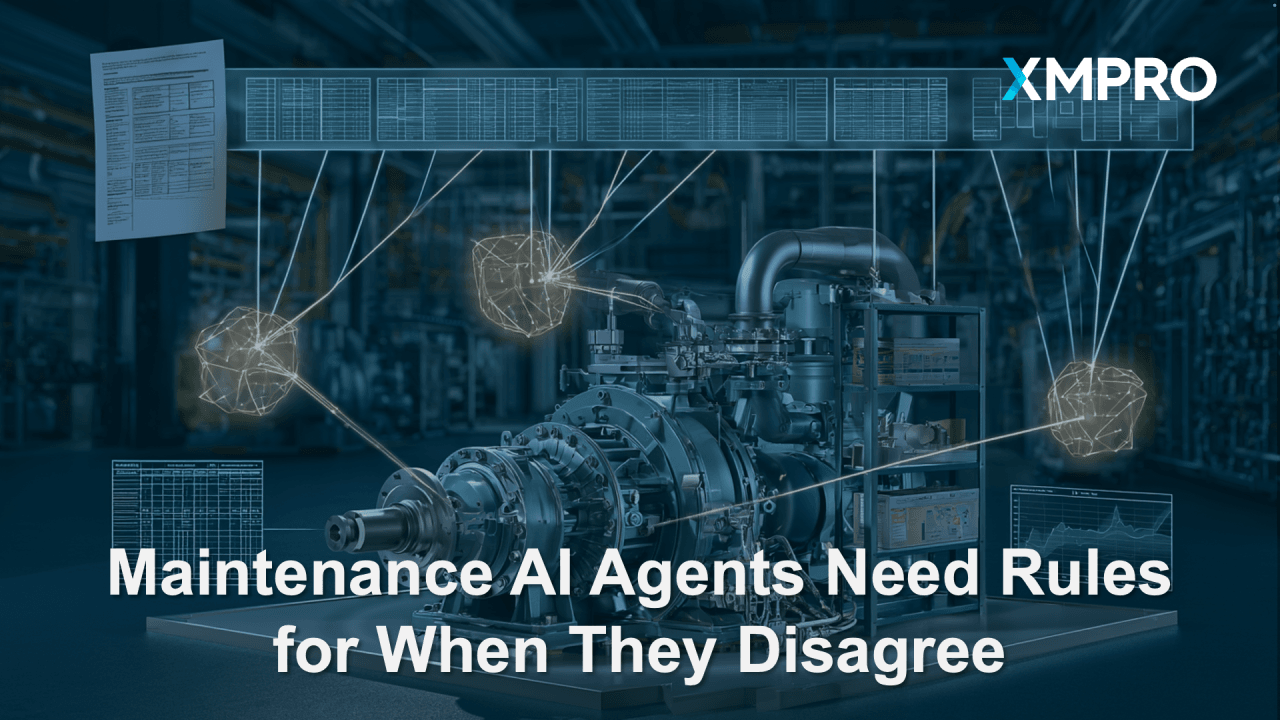
McKinsey shows what single AI agents can already do in maintenance. The harder problem starts when several of them work on the same plant.
Mike Doheny and colleagues at McKinsey warn, in their September paper Maintenance meets AI: A proven approach for asset-heavy industries, that companies often direct AI at one step of the maintenance process and only shift the bottleneck to another point in the value stream. Every agent example in the same paper works on one step. A reliability agent finds bad actors (the small number of assets that cause a large share of failures). A scheduling agent resequences and bundles work orders. A refinery team uses risk-based analytics to cut the scope of a turnaround, the major planned shutdown where a plant does its biggest maintenance jobs. Each one is useful, and each one optimizes its own piece of the work.
The value at stake is large. McKinsey estimates the average cost-saving opportunity across asset-heavy sectors at around 10 to 15 percent of total maintenance conversion costs (the operating costs of turning inputs into output, excluding raw materials). It also reports that companies rewiring maintenance this way capture around two to five percentage points of incremental margin in many cases, an indicative figure from its client work. McKinsey’s case for that value is end to end: it comes from reliability, planning, spare parts, turnarounds and contractor management improving together, which is where agents built for one step each start to disagree.
They are right that how AI gets built into the routines of planners, reliability engineers and technicians matters as much as the algorithm. The paper stops before the next stage, which some of its own examples have already reached.
The second and third agent
A global packaging manufacturer in the paper raised technician productivity by 85 percent with an agentic scheduling tool for maintenance. The scheduling agent estimates how long work orders will take from past jobs and proposes better schedules by reassigning, resequencing or bundling work. McKinsey reports that two more agents are in progress: one to assess inventory and material readiness, and one to prioritize work orders by urgency, safety, failure mode, location and the project plan.
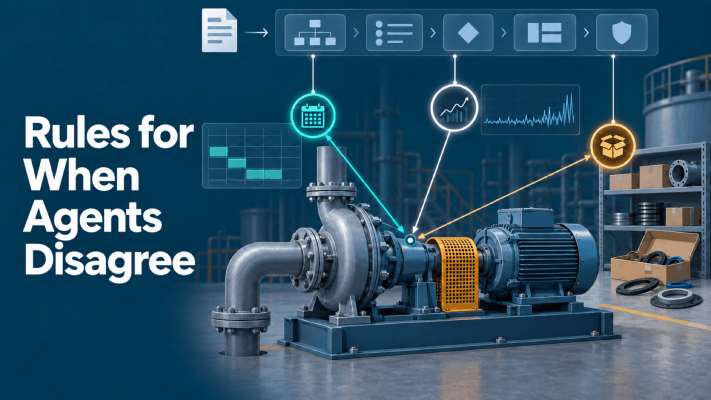
That is a team of three agents, a multi-agent system, working on the same work orders. Each has its own objective. The scheduler wants high wrench time, meaning the share of a technician’s shift spent on actual repair work. The readiness agent wants nothing to start without parts on the shelf, and the prioritization agent wants the most urgent and safety-critical work done first, even when that breaks up a schedule the first agent spent its effort building. Most days those objectives agree. On the days they do not, somebody has to decide which one wins.
Where the conflicts show up
Consider three situations built on the paper’s own examples. Each agent is right by its own measure in every one of them.
The scheduling agent bundles a pump repair into Tuesday’s shutdown window to avoid a second isolation (the work of safely disconnecting and locking out the equipment). The readiness agent knows the seal kit arrives on Thursday. An inventory agent is tuned to lower stock levels, as the airline in the paper did when it cut spare parts inventory by 14 percent. A reliability agent wants two spares held for a compressor that has failed twice this year. A turnaround scope agent marks an item as low-risk and pushes it to the next outage, the way the refiner in the paper found close to 35 percent of more than 500 discretionary items could wait or needed further review. The reliability agent has the same asset on its bad actor list.
Today these conflicts get settled in the weekly planning meeting. The planner, the reliability engineer, the stores supervisor and the operations lead sit at the same table and trade off risk, cost and production using rules that mostly live in their heads. When agents do the planning, those rules have to be written down before the work starts, because an agent cannot ask the person across the table what they meant. Without them the bottleneck McKinsey describes does not go away. It moves between the agents, and it moves faster than any weekly meeting can catch it.
What the rules look like
The rules an agent team needs fall into three kinds. Obligations are things that must happen: hold two spares for every safety-critical rotating asset. Prohibitions are things that must never happen: never defer an item on the safety-critical list, whatever its risk score says. Permissions are things an agent may do without asking: resequence work within a shift, provided no isolation changes. Every maintenance organization already has these rules, but most have never had to write them in a form a machine can apply, check and record against each decision. The paper’s six principles for scaling AI cover goals, teams, data, platforms, operating model and change management, and the closest it comes to this question is one sentence about bringing regulators along on safety and transparency.
These rules belong to the organization. A vendor cannot write them for you, and an agent should never invent them. They reflect a plant’s risk appetite, its contracts and the lessons from its last failure. They also change. A rule that made sense before a near miss may need tightening after it, and every agent has to follow the new version from that day on.
Agent teams already have two ways to settle a disagreement. Each agent has its own objective function, a scored list of the outcomes it is trying to improve, and the team has a shared objective that weighs those outcomes against each other. On top of that sits a consensus process. The agents exchange draft plans, flag where two plans claim the same equipment or score far apart on the team objective, revise their own plans, and hand the decision to a person if they still disagree after a set number of rounds. That is how XMPro’s agent teams work today.
Recommended by LinkedIn
Both methods trade one outcome against another. A rule is not open to trade. A plan that scores well on the team objective still may not defer an item on the safety-critical list, and no amount of agreement between agents changes that. So the rules have to sit outside the scoring and the negotiation, written in a form every agent checks its plan against, and that depends on getting them out of the documents first. Most maintenance rules sit in SOPs (standard operating procedures) written as PDFs for people to read. Searching those documents for the relevant passage whenever an agent needs it, a method usually called retrieval-augmented generation (RAG), is not reliable enough for rules. In one test on a public reference drawing, a retrieval-only answer read the set pressure of a safety relief valve (the pressure at which it opens to protect the equipment) as the pump’s normal operating pressure.
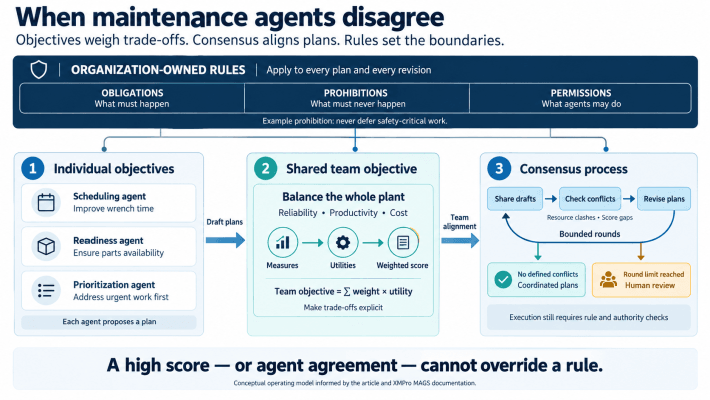
That is why we built a Procedural Intelligence Engine that turns SOPs into structured records, with each limit, step and prohibition stated explicitly so an agent can check its plan against it.
A test before adding the second agent
If you already run one maintenance agent and plan to add another, try this with your planning team. Write down which objective wins when the two agents disagree, which actions each agent may take on its own, and which actions it must never take. If the people in your planning meeting cannot agree on those answers, the agents will not settle the conflict for them. They will each keep optimizing their own step, and the value McKinsey measured in single agents will leak away at the handoffs between them.
McKinsey’s paper shows how far single agents have come in reliability, scheduling, spare parts and turnarounds, and it puts numbers on what they are worth. The next gains depend on whether those agents work as one team, and that comes down to whether the organization can turn the judgment in its planning meeting into rules every agent follows.
Source: Mike Doheny, Oskar Lingqvist and Patrick Neise, with Arturo Ricke, Daniel Araneda and Vivek Jha, Maintenance meets AI: A proven approach for asset-heavy industries, McKinsey & Company Operations Practice, September 2026. https://www.mckinsey.com/capabilities/operations/our-insights/maintenance-meets-ai-a-proven-approach-for-asset-heavy-industries. All figures and company examples in this article come from that paper.
Pieter van Schalkwyk is the CEO of XMPro, specializing in industrial AI agent orchestration and governance. Drawing on 30+ years of experience in industrial automation, he helps organizations implement practical AI solutions that deliver measurable business outcomes while ensuring responsible AI deployment at scale.
He authored the Industrial AI Agent Manifesto, published by the Digital Twin Consortium in February 2026, a governance framework for trustworthy autonomous operations
Our GitHub Repo has more technical information. You can also contact myself or Gavin Green for more information.
Read more on MAGS at The Digital Engineer
How this was made: I worked with Claude to check sources, draft from my direction and edit. I do not publish anything I have not rewritten myself.
This article originally appeared on XMPro CEO’s LinkedIn blog, The Digital Engineer, on 2 October 2026.